

Strolling through the streets of Ancoats, you can hear laughter, the noise of passing cars, the smell of freshly ground beans, the clinking of glasses, and conversations lasting until morning. In the 21st century, Ancoats is one of Manchester’s most vibrant districts. It is built up with new high-rises, parks, and entire neighbourhoods. But, it is worth noting that amidst the new development, Ancoats preserves a part of the old city – the sturdy red-brick walls and tall windows of the mills. Here, the city authorities have re-imagined Manchester’s industrial heritage in the best way possible. After all, long before Ancoats became as everyone knows it in the 21st century, it was something completely different – the world’s first industrial suburb. More at manchester-future.
Ancoats’ Ancient Roots
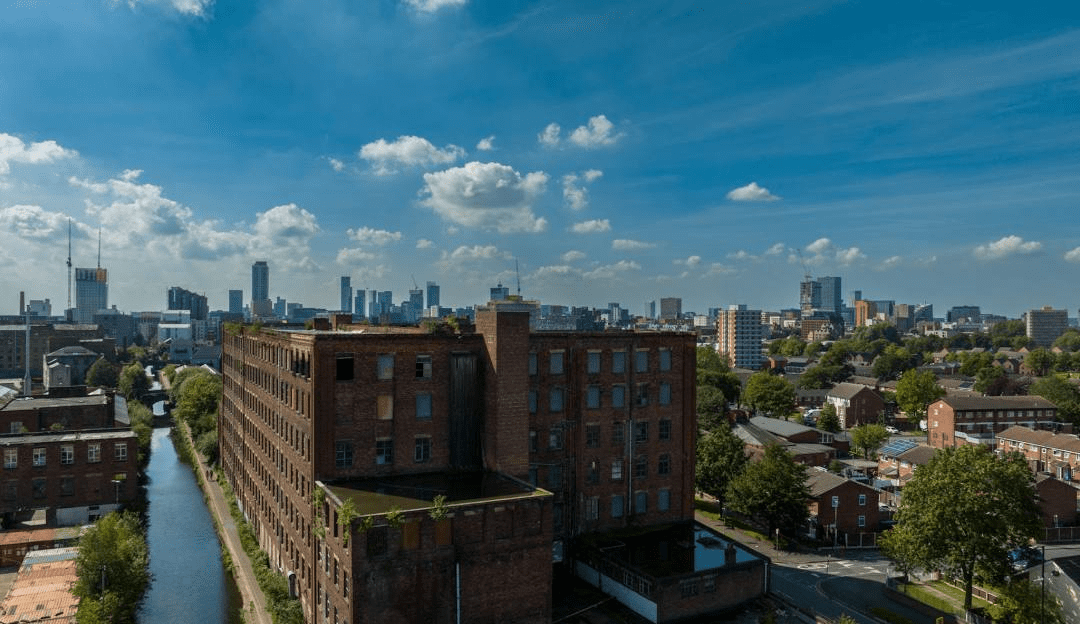
The name of the Ancoats district comes from the Old English “ana cots”, which can be translated as “lonely cottages”. It was first mentioned in documents in 1212 under the name Elnecot. By 1320, Ancoats was considered one of the eight hamlets that were part of the township of Manchester in the parish of Salford.
Initially, it was a modest settlement. There were several cottages and farmhouses located in the area of the modern Ancoats, Butler, and Newton streets. It was also here in the Middle Ages that Ancoats Hall appeared – a manor house that became an important landmark in the area. And in the 14th century, these lands were bequeathed to the local gentry by Henry de Ancoats.
Located between the rivers Medlock and Irk, this village eventually transformed into one of Manchester’s key industrial districts, and later – into a symbol of urban gentrification and a new cultural renaissance.
The Start of the Factory Boom: Ancoats’ First Mills
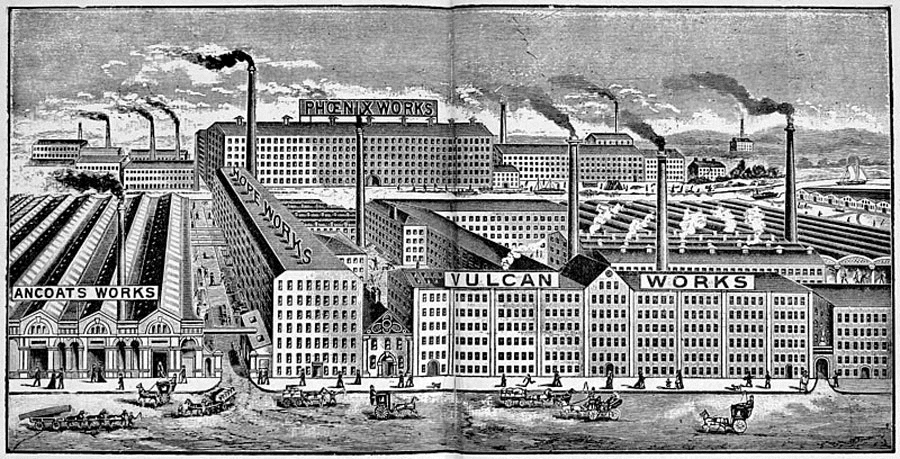
In the late 18th and early 19th centuries, Manchester was transforming into the heart of the Industrial Revolution. The once vast and empty field of Ancoats, located on the outskirts of the rising city, became the epicentre of the booming cotton industry.
By the early 1800s, mills, huge textile factories, plants, and warehouses began to appear here one after another. These were innovative structures that propelled Manchester to the forefront of global textile production. The factories housed innovative spinning machines for that time, and thousands of workers were employed here, many of whom were women and children.
With the opening of the Rochdale Canal in 1804, Ancoats transformed into an industrial epicentre. Access to water and transport routes accelerated the growth of the textile industry, and mills began to appear rapidly throughout the area. Among them were Victoria, Wellington, Brunswick, India, Phoenix, Beehive, Paragon, and Royal Mill, as well as many others.
These factories became a symbol of Manchester’s industrial might and provided work for thousands of people. The Murray brothers, owners of Decker Mill, were among the most prominent entrepreneurs of that time. Thanks to such unprecedented growth, Ancoats earned the nickname “the world’s first industrial suburb”.
And mills such as Murray’s Mills, Royal Mill, and Beehive Mill were among the largest and most advanced in the world. At the peak of its development, Manchester was known as “Cottonopolis”, and Ancoats was its main industrial driving force.
The Architecture of Ancoats’ Old Mills
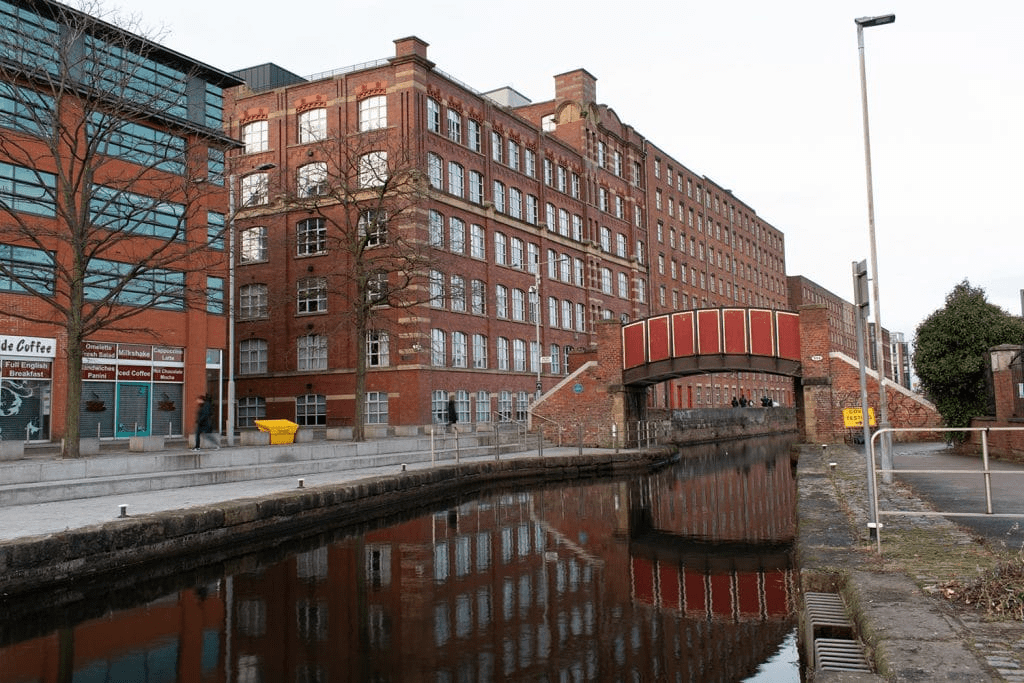
The architecture of the old mills in Ancoats, Manchester, is one of the most striking symbols of industrial heritage not only of the city but of Great Britain as a whole. These buildings were constructed in the 18th and 19th centuries, during the era when Ancoats was considered “the world’s first industrial suburb”. Many of them have survived to this day and are architectural landmarks.
The main architectural features of the Ancoats mills include red brick and massive construction. Most mills of that time were built from the characteristic red brick, popular in Victorian England. This gave the buildings an austere, yet majestic appearance. The walls were incredibly thick and strong, designed to withstand heavy machinery and many years of operation.
Another architectural feature of the old mills was high ceilings and wide spans. The mills were designed to allow as much natural light inside as possible. Therefore, the buildings had huge windows, often with cast-iron frames, and spacious, open-plan rooms – to accommodate looms and thousands of workers.
The old industrial sites in Ancoats were also multi-storey. The mills often reached 4-6 storeys, with high ceilings on each level. This was due to the fact that land within the city was expensive to use, so the industrial zone grew upwards.
Many factories had their own water towers and tall brick chimneys. This was necessary to power the steam engines.
At the same time, the external architectural appearance of the mills was simultaneously simple and austere. They had the fewest decorative elements, but maximum utility. But it is worth noting that in the 21st century, it is precisely this minimalism of the buildings that provides a special industrial charm, so valued by modern architects.
In the 2020s, many of these mills, including Beehive Mill, Royal Mill, and Paragon Mill, have been converted into stylish apartments, offices, galleries, and creative spaces. Their brick facades, huge windows, and traces of the machine age remain almost untouched. These are not just buildings, but the architectural heritage of Manchester’s industry, organically integrated into the modern city.