

Manchester, a city widely known for its textile industry, was once a small settlement that grew into a vast metropolis driven by the textile trade. People from all over the world flocked here in search of work. New residential neighborhoods, factories, schools, and universities were built to accommodate the influx. By the 18th to 20th centuries, Manchester was a rapidly developing city. As the city expanded to unprecedented scales, the need for public transportation became evident. The evolution of Manchester’s public transport system is a captivating story that reflects the city’s growth, challenges, and resilience. At the center of this narrative lies the Manchester Corporation Transport, an organization that played a key role in shaping the city’s transport network. Learn more at manchester-future.
How Did Public Transport in Manchester Begin?
In the 21st century, Manchester residents enjoy modern conveniences and various modes of public transportation, including buses, trolleybuses, trams, and the Metrolink. It is hard to imagine a time when none of these existed.
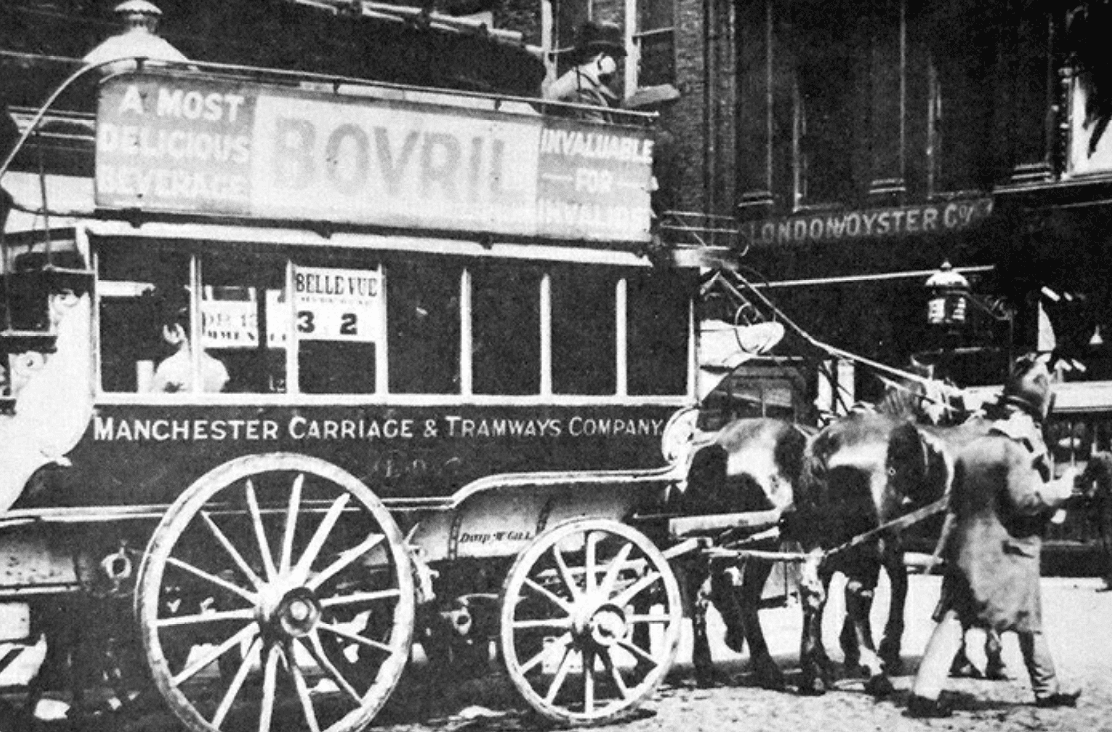
At the beginning of the 19th century, Manchester’s public transport system began with horse-drawn omnibuses. These were carts pulled by horses, a far cry from the modern public transportation we know today. Yet, at the time, omnibuses were a groundbreaking innovation that marked significant progress in urban mobility.
Development of Public Transport in Manchester
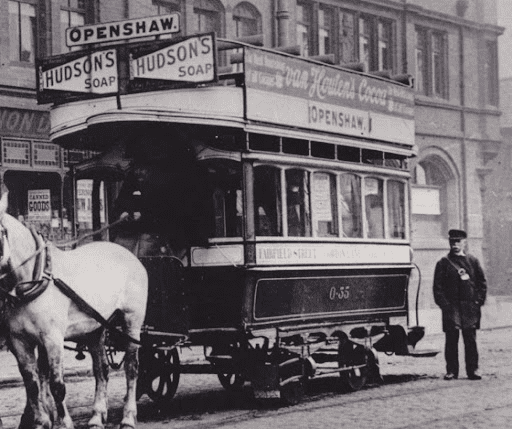
The history of public transport in Manchester is closely tied to John Greenwood, a tollkeeper from Pendleton. In 1824, Greenwood established the first horse-drawn omnibus service in Britain. This service operated between Pendleton and Market Street in Manchester.
The transportation services offered by Greenwood proved incredibly popular, making his business highly successful and profitable. Greenwood soon expanded his fleet, acquiring more omnibuses. By the mid-19th century, Manchester was served by 64 omnibuses that connected the city center to outlying suburbs. Many of these vehicles were operated by competing companies rather than the Manchester Corporation Transport. For half a century, omnibuses, exclusively run by private companies, dominated public transport in Manchester until the advent of trams.
A New Era in Manchester’s Public Transport
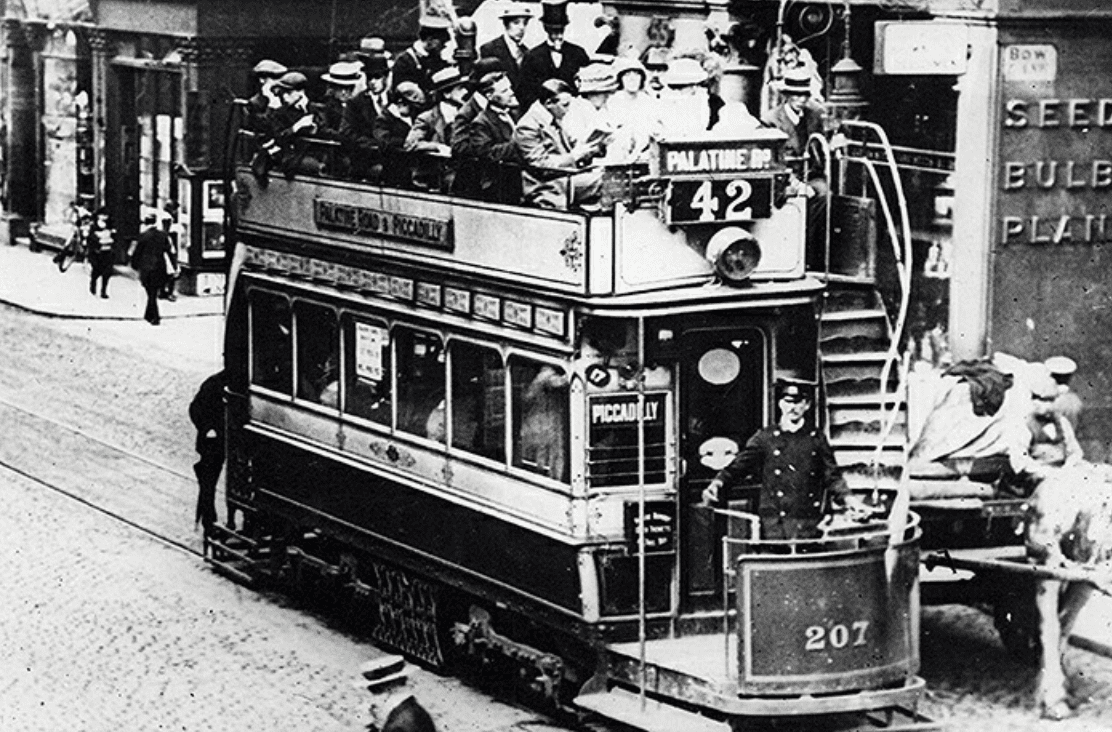
The electrification of the city and the introduction of trams at the end of the 19th and the beginning of the 20th centuries marked a pivotal moment in Manchester’s transport history. During this transformative period, the Manchester Corporation Transport was established. In 1901, the Corporation transitioned from horse-drawn vehicles to electric trams, improving efficiency, speed, and reliability and making trams the backbone of the city’s public transport network.
The tram network quickly expanded, connecting various parts of the city and its suburbs. This growth not only facilitated easier movement for residents but also supported Manchester’s industrial and economic development. Trams became an iconic symbol of Manchester. By the end of 1901, additional tram routes were established between:
- High Street and Blackley
- High Street and Queens Park
- High Street and Moston Lane
- Cheetham Hill Road and Rochdale Road
- Deansgate and Gorton
The first tram cars operating in Manchester included four-wheeled and bogie open-top double-deck cars with “Brush” and “Milnes” bodies mounted on “Brill,” “Brush,” or “Peckham” trucks. Later, single-deck cars with “Milnes” 48-seat bodies mounted on “Brill 22E” trucks appeared.
Initially, the depot on Queens Road could accommodate only 252 cars. However, as the tram network expanded, by 1910, the Corporation operated 582 tram cars and maintained over 100 route miles. This necessitated the construction of additional facilities, including a new tram depot at Princess Road in Moss Side, which opened in 1909 and could house nearly 300 cars.
The Motorized Era of Buses
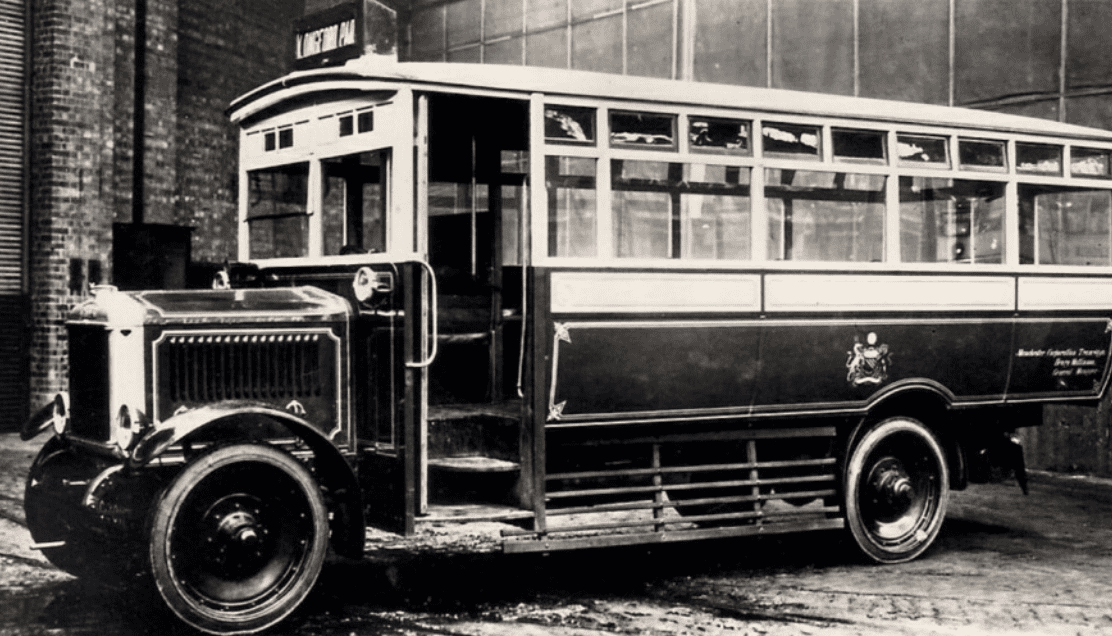
The early 20th century brought significant changes to Manchester’s transportation system. Public transport networks developed rapidly with the introduction of not only new tram lines but also new modes of transportation.
Manchester became one of the first cities in Britain to experiment with motorized buses. In 1906, the Manchester Corporation Transport launched its first motorized bus route, connecting the tram stop in West Didsbury to the Church Inn Hotel in Northenden. The motorized bus entirely replaced the horse-drawn buses previously serving this route.
The Corporation initially ordered three motorized buses from the local firm “Crossley Brothers.” As the popularity of buses grew, Manchester opened another route from West Didsbury to Cheadle.
Not everyone welcomed the new form of public transport with open arms. Residents of West Didsbury, for instance, frequently complained about the noise and exhaust emissions from the buses.
Conclusion
The development of Manchester’s public transport system is a testament to the city’s adaptability and progress. From horse-drawn omnibuses to electric trams and motorized buses, each phase of transportation evolution reflects the dynamic growth of the city and its efforts to meet the needs of its residents. Today, Manchester’s well-developed transport network stands as a lasting legacy of the Manchester Corporation Transport’s innovations.