
Manchester was once primarily associated with red brick, industrial warehouses, and factories. But since the second half of the 20th century, its appearance has been rapidly changing. This became particularly noticeable when a new symbol of the city, Deansgate Square, was erected near the southern part of the city centre, by the River Irwell. This complex is not just a collection of residential skyscrapers but a true turning point in Manchester’s architectural history. More at manchester-future.
From Brick to Glass: How Manchester’s Look Has Changed
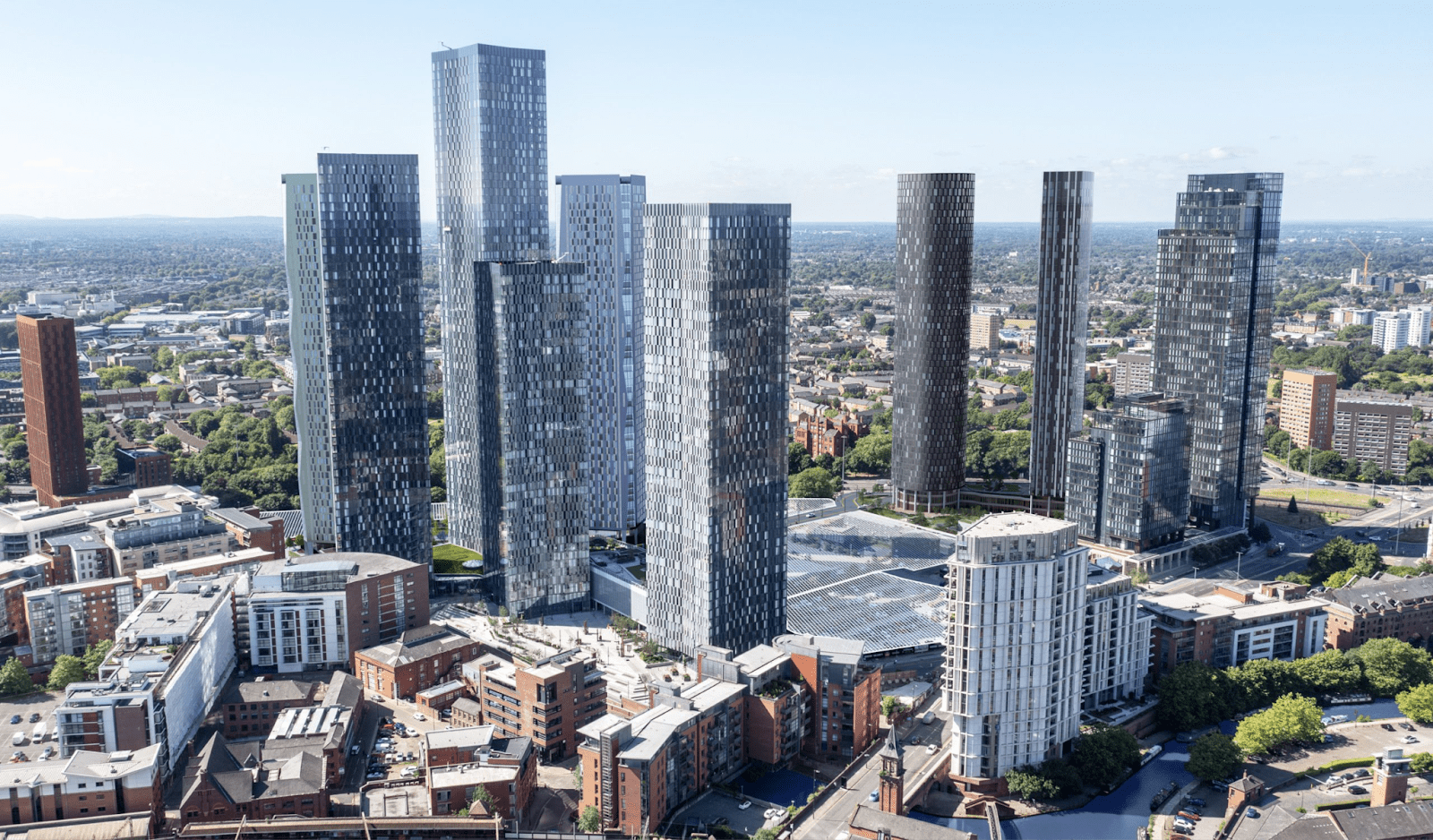
The project to transform the area received support not only from the local authorities but also from private development companies. One of the key growth points was the development of the Deansgate Square quarter—an ambitious project that includes four modern towers, which are now some of Manchester’s tallest buildings in the 21st century. These skyscrapers became a symbol of the city’s architectural transformation: with their arrival, Manchester gained a skyline that can be boldly compared to London’s.
However, the construction of high-rises is not just about aesthetics. They became a response to a number of urban challenges: a housing shortage, a growing population, and the desire to attract investment. The towers provided thousands of new flats, offices, and commercial spaces, as well as infrastructure—fitness centres, shops, restaurants, and green areas for residents. As a result, the area came to life. Young professionals, families, and investors began moving in.
It’s important to note that this approach wasn’t limited to the Deansgate area. In the second half of the 2010s, the city council began promoting similar projects in other parts of the city: in the Nuneaton Street area, around Piccadilly Station, and along the River Irwell. Manchester started to actively collaborate with international architects and companies to build a modern, sustainable, and well-planned urban city.
This shift in architectural policy also led to controversy. Some residents and architectural historians fear that Manchester could eventually lose its unique character, dissolving into the glass and concrete of new towers. They stress that the city is renowned for its Victorian quarters, red-brick textile mills, and industrial charm. However, the authorities aim to strike a balance: new high-rises are being built with the urban landscape in mind, while historic buildings are being restored and given a new lease of life as cultural spaces, hotels, or co-working hubs.
Thus, Manchester’s architectural direction in the 21st century is a blend of the past and the future. The city is not forgetting its roots, but it is also not afraid to grow upwards, change, and adapt to the demands of the modern era. High-rise construction is just one part of a larger process in which Manchester is rediscovering itself, both for locals and for the entire world.
The First Idea: The 2007 Project
As far back as 2007, the first serious initiative to develop the Great Jackson Street area emerged. The project proposed the construction of five high-rise buildings, which were planned to house around 1,100 residential flats, 100 serviced apartments, a hotel, offices, shops, and public spaces. A large car park was also planned, indicating the project’s focus on convenience and multi-functionality.
The “Block D” skyscraper drew particular attention. At 49 storeys and 150 metres high, it was set to become Manchester’s tallest building at the time, surpassing the height of the famous Beetham Tower (169m). This was intended as an architectural statement about Manchester’s future as a modern, vertical city.
The project received official approval from the City Council in early 2008, and in 2011, the developer requested an extension of the planning permission, which was also granted. However, due to the 2008 economic crisis and the ensuing uncertainty, the project’s implementation was put on hold. The area fell silent once again, but not for long.
The Revamped Concept of 2016
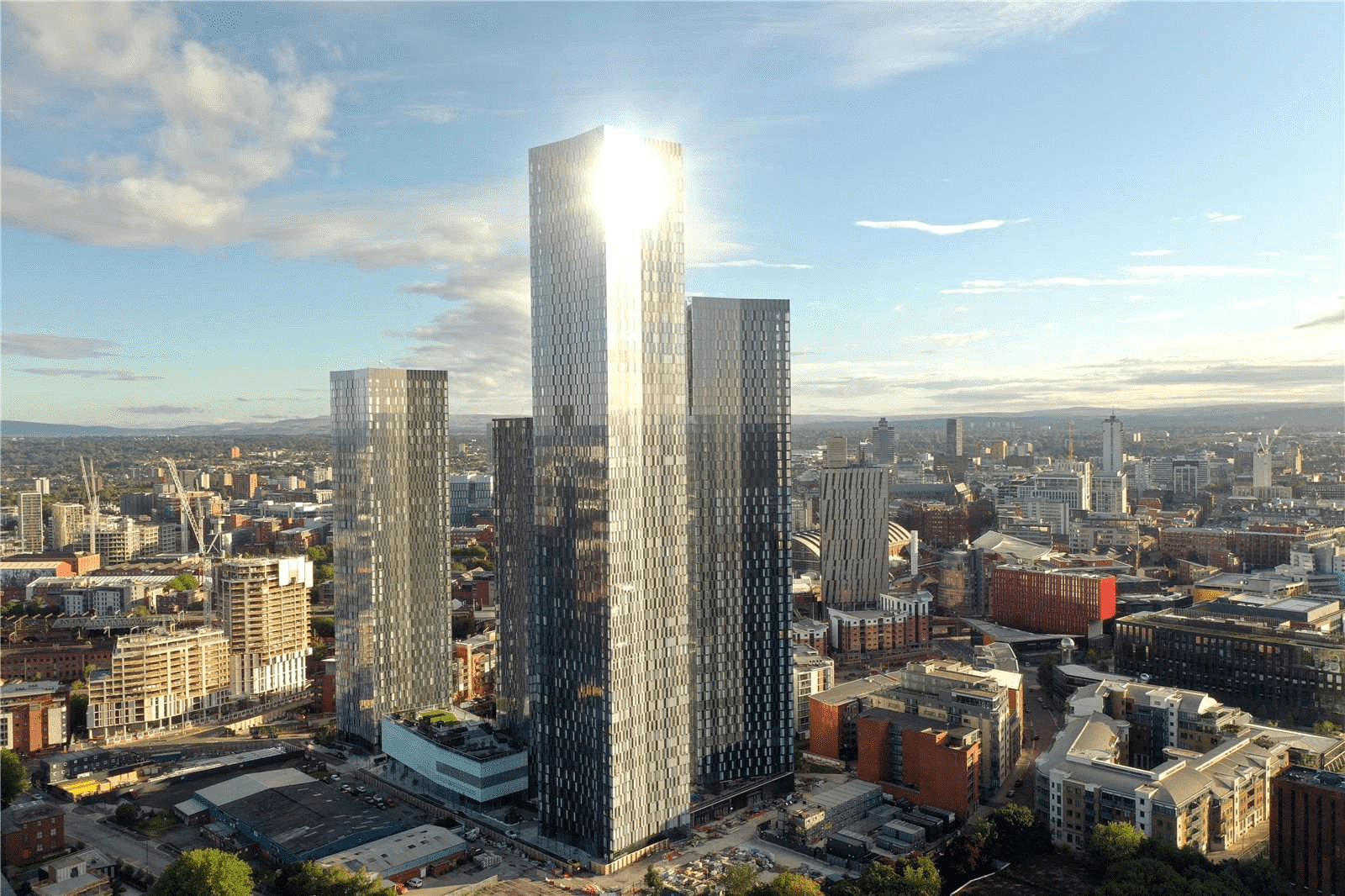
Almost a decade later, the project was revived in a new format. In 2016, the construction company Renaker Build took on the project in partnership with the architectural practice SimpsonHaugh and Partners. The architects redesigned the original scheme, retaining its ambition but adapting it to modern realities and the city’s needs.
The updated version proposed the construction of four skyscrapers, each with its own unique height and function:
- South Tower – 64 storeys, 200.5 m (the tallest building in Manchester)
- East Tower – 50 storeys, 157.9 m
- West Tower – 44 storeys, 140.4 m
- North Tower – 37 storeys, 122 m
These skyscrapers not only created a modern city skyline but also laid the foundation for a new residential and business cluster in an area previously considered inaccessible and isolated.
The project received official approval from Manchester City Council on 30 June 2016. This marked the starting point for the large-scale transformation of Great Jackson Street, turning a neglected area into one of the city’s most dynamically developing zones.
How Did It All Unfold?
Construction began in the summer of 2016. The South Tower was built first, followed by the 141m West Tower. A year later, work started on the other two towers of the complex—the North Tower (122m) and the East Tower (158m). All four buildings were fully completed by the end of 2020. The complex was named Deansgate Square and became a symbol of Manchester’s new architectural era—modern, large-scale, and comfort-oriented.
But it’s worth noting that the area’s development didn’t stop there. After Deansgate Square, new skyscrapers appeared on Great Jackson Street. Among them are The Blade and Three60, both standing at 154m. In 2022, the construction of Elizabeth Tower was completed—153 metres of modern apartments with panoramic views across Manchester.
The Significance of the Development for Manchester
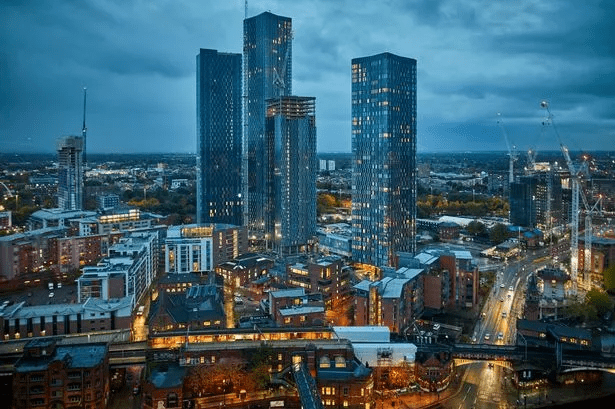
The complex and its neighbouring towers have not only changed Manchester’s architectural appearance but also revitalised a previously forgotten area. A modern urban space is forming around the new buildings, complete with residential flats, cafes, shops, and infrastructure. People live, work, and relax here. This area has become an example of how targeted development can revitalise an entire urban landscape.
The complex consists of four towers, the tallest of which—the South Tower—is 201 metres high with 64 storeys, making it the tallest building in the city and one of the tallest in the UK outside of London. This new architectural achievement has already put Manchester on the map of European cities that are rapidly building upwards. In a city that for decades grew outwards, this vertical breakthrough symbolises a new approach to space.
Deansgate Square is located near Manchester’s historic core, so its silhouette creates a dramatic contrast with the Victorian architecture. The gleaming glass towers reflect the sky, clouds, and the surrounding city, while also mirroring a shift in architectural priorities: from functionality to visual impact, from an industrial past to a futuristic appeal.
Deansgate Square is not just a place to live. It represents a new level of infrastructure: a private swimming pool, a gym, lounge areas, and spaces for work and leisure. Everything has been designed for the modern urban resident who values speed, style, and comfort. At the same time, critics point to the risk of a growing social divide—the apartment prices here are unaffordable for the majority of the city’s residents.
Deansgate Square has become a visual marker of the changes Manchester is undergoing. Its contours are visible from dozens of kilometres away—clearly indicating the direction in which the city is moving. Manchester is no longer just an industrial hub; it is a metropolis embracing innovation, luxury, and a new urban style. And while not everyone agrees with this transformation, one thing is undeniable: Deansgate Square has become the new calling card of Manchester’s contemporary architectural style.

