

Manchester has long transformed from an industrial powerhouse into an innovative metropolis, setting the tone for urban technologies in the UK and globally. One of the most significant initiatives has been the “CityVerve” project —the first large-scale platform created to optimise energy, transport, and city infrastructure. More on manchester-future.
The aim of “CityVerve” was ambitious: to make Manchester the smartest city in the country, where every street lamp, bus stop, and public transport route operates based on precise data.
“CityVerve” demonstrated that the future of urban infrastructure lies in the integration of sensors, analytics, and artificial intelligence. It is thanks to this project that Manchester has become a prime example of a “smart city” for dozens of other metropolises.
How the “CityVerve” Project Emerged and Why Manchester Became its Testing Ground
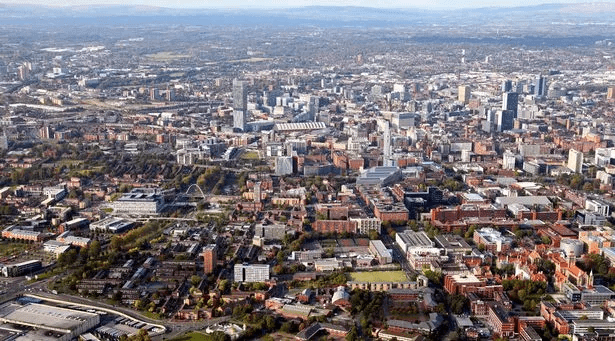
The story of “CityVerve” began long before sensors appeared on streetlights and bus stops. For over a decade, Manchester had been positioning itself as a city aspiring to become the UK’s technology capital. Digital infrastructure was actively developed here, innovation clusters were operating, and universities fostered an environment for experimenting with cutting-edge technologies. This is why, when the UK government announced the national “IoT UK Challenge” competition in 2016, Manchester was one of the strongest contenders.
The project received support from Innovate UK, which was the key starting point for its launch. Crucially, “CityVerve” was not merely a technological experiment—it was conceived as a demonstration of what the “smart city” of the future would look like in real-world conditions. Manchester was ideally suited for this. Its urban structure was complex, multi-layered, and dynamic: old industrial districts bordered new business quarters, traffic congestion was constantly increasing, and energy grids were operating at their limits.
It was this very “urban mosaic” that led to Manchester being chosen as the main site for implementing IoT technologies. Here, it was possible to test not just one system, but several simultaneously: transport, energy, security, navigation, and the environment.
Another unique feature was the unprecedented collaboration across different sectors. More than twenty partners—from technology giants to local universities and the city council—created the country’s first network where data was collected, analysed, and used jointly. This was not just a technical project, but an ecosystem that united the private sector, public bodies, and academia.
The primary goal of “CityVerve” was to create a city that “thinks,” sees, reacts, and makes decisions based on real-time data.
In practical terms, this meant a shift from traditional urban management to a model where digital information becomes the foundation for modernisation:
- Lighting operates based on actual need, not “according to a schedule”;
- Transport moves in accordance with real flow patterns;
- Energy consumption is optimised automatically;
- Air quality and ecology are monitored every second.
All these processes were intended to be unified on a single platform, which became the main breakthrough of “CityVerve”. Manchester effectively transformed into a living laboratory for creating a digital city, demonstrating how technology can change a metropolis not in theory, but in everyday reality.
Sensors and IoT Technologies: Infrastructure That Works Autonomously
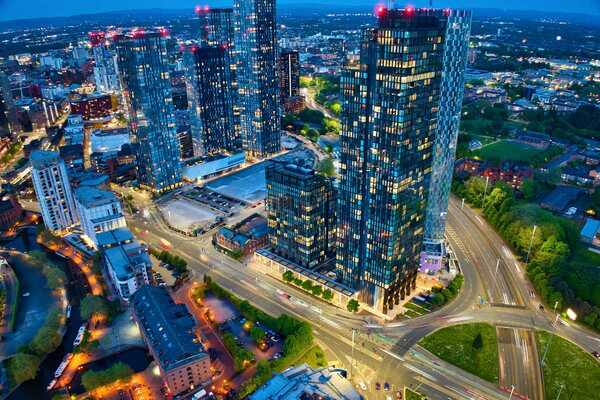
One of the key solutions of “CityVerve” was the installation of sensors on street lighting, transport, and utility networks.
These devices collected data on:
- Illumination levels;
- Traffic movement;
- Air quality;
- The number of pedestrians;
- Temperature and humidity;
- Energy consumption.
The smart lighting system was particularly important. Streetlights turned on and adjusted their brightness not according to a timer, but depending on the actual situation—pedestrian movement, weather, or ambient light levels.
This allowed for a reduction in energy consumption and maintenance costs, while also creating safer routes in the evening.
Smart Transport: Optimising Movement and Improving Resident Comfort
“CityVerve” significantly changed the approach to public transport, making it more transparent and convenient. The following were implemented:
- Intelligent bus stops displaying real-time vehicle arrival;
- Bus monitoring to allow for schedule adjustments;
- Sensors on cycle lanes to enhance safety;
- Routes with the cleanest air for pedestrians and cyclists.
Based on the collected data, the city could modify infrastructure, alleviate traffic bottlenecks, and forecast congestion in key areas.
Thanks to “CityVerve”, transport in Manchester became not only faster but also greener.
Energy Efficiency as Manchester’s Strategy for the Future
Within the “CityVerve” project, energy efficiency ceased to be just a buzzword or a declaration in city strategic documents. It was transformed into a practical, manageable, and measurable process that impacted Manchester’s operation daily. The smart data platform gave the city the ability to see its own energy consumption not as general monthly reports, but in real-time—dynamically, in connection with resident behaviour, traffic flow, and weather changes.
Sensors installed on street lighting, public transport, buildings, and utility networks formed a powerful analytical map of the city. This enabled the automatic regulation of streetlight brightness based on traffic intensity, the redirection of energy to areas with increased load, and the prevention of accidents —the system identified anomalies and signalled potential failures before they became problems.
The smart energy model allowed for a significant reduction in city budget expenditure: instead of “fuelling” infrastructure blindly, the city began to operate on the principle of precise, personalised energy distribution. The improved forecasting system helped to predict peak loads, such as rush hour travel or evening lighting surges, and prepare the energy grids to avoid overload.
Crucially, this technological transformation had a significant environmental impact. The reduction in electricity consumption directly contributed to a decrease in emissions, which is particularly relevant for industrial cities like Manchester. Instead of simply implementing old engineering solutions, the city began to build a new model—a model of sustainable, long-term development where every watt of energy matters.
“CityVerve” transformed energy efficiency from a theoretical strategy into a clear mechanism for urban management: measurable, predictable, and controllable. Manchester gained not just a tool for saving money, but a foundation for future transformation—a city that lives at the pace of technology while doing so responsibly and ecologically.
Manchester Sets the Pace for Smart City Development
The project was completed in 2018, but its infrastructure and solutions continue to operate and evolve.
“CityVerve” has influenced national digital infrastructure strategies and become a model for other UK cities.
In 2025, Manchester is considered a leader in Smart City technologies in Europe, and “CityVerve” is proof that the future of cities is possible today.
Smart sensors, energy-efficient systems, effective transport, and urban analytics—all of this has already become a part of the metropolis’s life.
“CityVerve” did not just make Manchester smarter—it showed what a modern city that cares about its residents, economy, and ecology can be.