

The Victoria Bridge is an iconic structure in Manchester. It is one of the city’s oldest architectural landmarks, reflecting Manchester’s rich history and industrial heritage. Opened in 1839, the bridge became a crucial part of Manchester’s transport infrastructure, connecting the northern and southern parts of the city. Its unique construction was considered a marvel of engineering at the time. Named after Queen Victoria, who had just ascended to the throne, the bridge quickly became one of the most famous symbols of old Manchester. Read on at manchester-future.
Predecessor of the Victoria Bridge – Salford Old Bridge
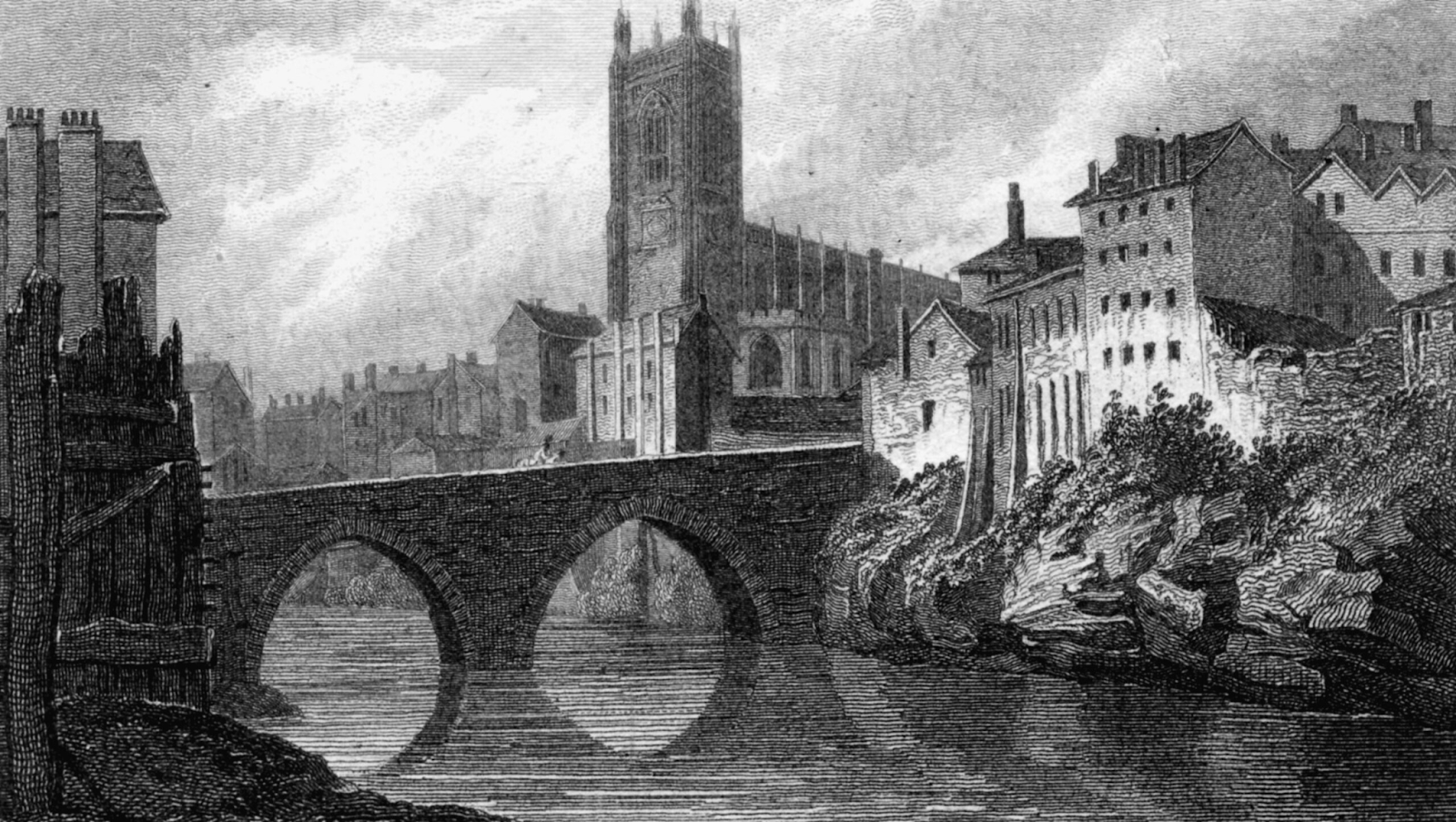
Many Manchester residents are unaware that before the Victoria Bridge spanned the River Irwell, it was preceded by the Salford Old Bridge.
The Salford Old Bridge was regarded as the oldest bridge in the region. Although its exact age remains undetermined by archaeologists and historians, estimates from the Lancashire and Cheshire Antiquarian Society suggest that it was built between 1365 and 1368. Records indicate that Thomas del Booth, a yeoman from Barton, bequeathed £30 for its maintenance in his will.
This ancient bridge, constructed in the 14th century, stood at a ford from which Salford derived its name. The name “Salford” originates from the Old English word “Sealhford,” meaning “a ford by the willow trees,” referencing the willows that once lined the banks of the River Irwell.
The Salford Old Bridge was a narrow stone structure with three Gothic-style arches. Additionally, a chapel built by Thomas del Booth stood on the central pier of the bridge. By the 16th century, this chapel had been repurposed as a prison.
For centuries, the Salford Old Bridge served as a vital crossing over the River Irwell until it was replaced by the Victoria Bridge. In 1836, Salford’s city authorities decided to replace the outdated structure due to its narrow passage, steep incline, and primitive design.
The Emergence of the Victoria Bridge in Manchester
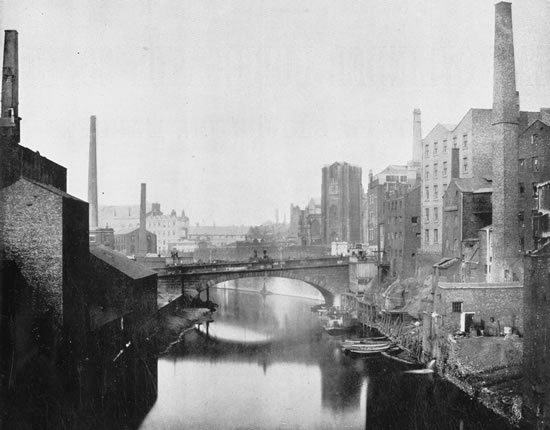
In 1839, the Salford Old Bridge was replaced by the Victoria Bridge. Its foundation stone had been laid in 1838.
Constructed from sandstone, the Victoria Bridge featured a single arch, showcasing the engineering advancements of the period. The sandstone was likely sourced from nearby Bury. The cobblestone span over the River Irwell measures approximately 100 feet. The entire structure is lined with rusticated voussoirs and topped with a straight cast string course. In the 19th century, the bridge was also adorned with four ornate gas lamps, enhancing its architectural charm.
Initially budgeted at £10,800, the construction costs rose to £20,800 due to project modifications.
The bridge was named in honor of Queen Victoria, who ascended to the throne in 1838. It was officially opened on the first anniversary of her coronation.
Following its inauguration, the Victoria Bridge quickly became a vital link between Manchester and Salford, facilitating the movement of people and goods during the rapid industrialization era. This engineering masterpiece not only contributed to the city’s economic growth but also symbolized a new era under Queen Victoria’s reign.
The Significance of the Historic Bridge to Manchester
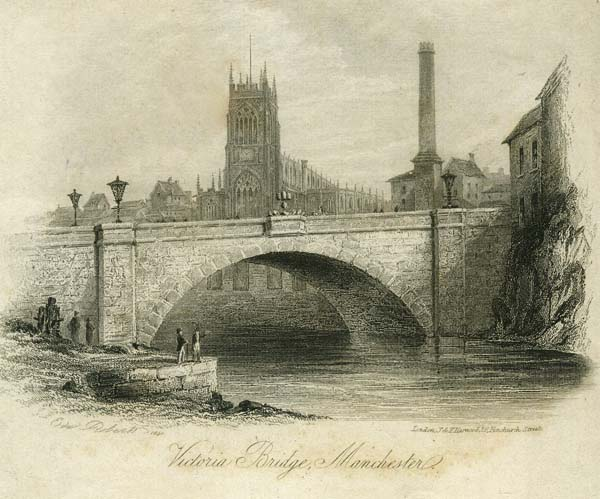
In the 21st century, the Victoria Bridge is considered one of the oldest in the country. It is not just an architectural marvel and a historic legacy of Manchester but a testament to the city’s dynamic development over the centuries. During the 19th and 20th centuries, it was celebrated in various publications for its beauty and grandeur, described as not merely a transportation element but a jewel of the city. In 1988, the Victoria Bridge in Manchester was designated as a Grade II listed architectural monument.
Throughout its history, the Victoria Bridge has witnessed significant events and transformations in Manchester. It withstood German bombings during World War II and bore silent witness to the city’s evolution—from the cradle of the Industrial Revolution to a bustling cultural and economic hub of Great Britain.
To preserve its architectural integrity, the bridge has undergone numerous renovations. Until 2012, the road over the bridge allowed only one-way traffic. Following traffic reorganization, nearby streets were converted into pedestrian zones, and the road across the bridge was adapted for two-way traffic.
The Victoria Bridge undeniably has a rich and vibrant history. Despite its age, it remains a crucial part of Manchester’s urban infrastructure in the 21st century, enabling safe two-way traffic and pedestrian access across the River Irwell. A journey or stroll across the Victoria Bridge today is much more than just a commute—it’s an encounter with the city’s historic past.