

The clock atop Manchester Town Hall was constructed in the late 19th century. It is not just a municipal timepiece but a true symbol of the city’s rich industrial heritage. Designed to be visible from various parts of the city, its massive clock face has been an integral part of life for the people of Manchester for decades. Many passersby have admired its grandeur without knowing the story behind its creation. Read more at manchester-future.
Historical Origins of the Chapel Clock
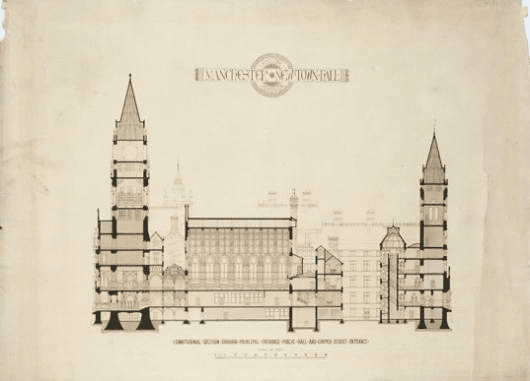
Although Manchester’s first town hall appeared on King Street in 1820, it did not include a clock tower. Similarly, the second town hall, constructed on Albert Square in 1877, initially lacked a chapel or a clock tower. The chapel was added to the second town hall only two years later, in 1879.
About the Clock Chapel
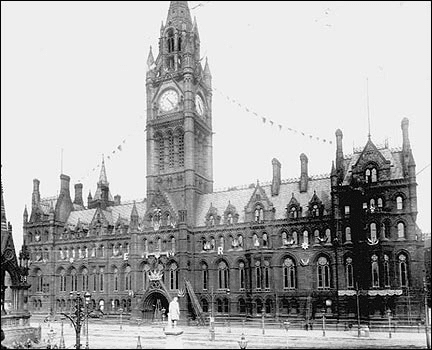
The chapel’s history dates back to 1879 when four clock faces were installed atop Manchester Town Hall during the winter of that year.
An inscription, “Teach us to number our days,” was added to the clock. This phrase remains visible from Albert Square to this day, even in the 21st century.
The clock mechanism, which drives the hands, is housed at the top of a spiral staircase consisting of 173 steps. At the end of the 19th century, this structure was considered a marvel of engineering. Each of the four clock faces was initially illuminated by gas lighting. The clock’s size is impressive: each face measures 15.9 feet in diameter, with the hour hands spanning 6 feet and the minute hands 9.9 feet. The spacing between minute markers on the clock face measures 9.5 inches.
The clock’s internal mechanism is a masterpiece of 19th-century engineering. This particular design was unique, with only five such mechanisms ever created. The one installed in Manchester Town Hall was the first and remains the largest.
Restoration of the Chapel Clock
Like many historical and architectural landmarks in Manchester, the chapel and its clock eventually required restoration.
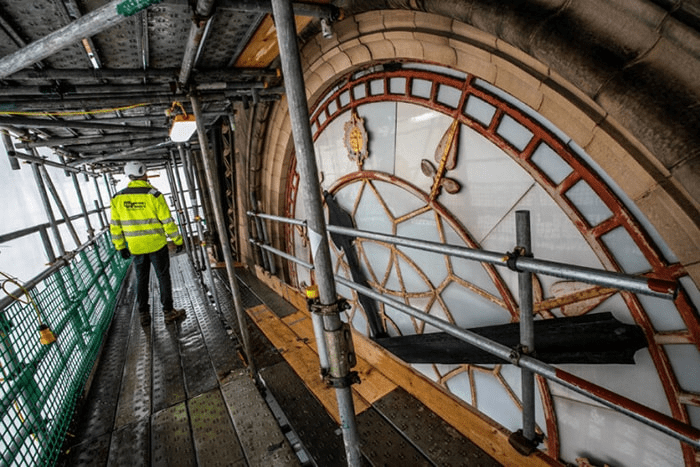
One of the most extensive restoration efforts took place in the 2020s. During this project, all four clock faces, the mechanism, and the hands were temporarily removed from the top of Manchester Town Hall. These efforts were part of a comprehensive restoration project aimed at modernizing the building while preserving its historic integrity.
The first step in the restoration involved disassembling and cleaning parts of the clock mechanism and replacing its weight-bearing lines. The clock, showing signs of wear, needed meticulous restoration. The cast iron clock faces bore rust, peeling paint, and fading gold leaf due to prolonged exposure to the elements.
The clock’s glass panels, heavily damaged during World War II bombings, were also in poor condition, with many cracked. During the restoration, each glass panel was removed, inspected, and cleaned. While some original glass was reused, much of it was too damaged and required replacement. Additionally, all metal components were cleaned, treated, and repainted in their original colors. The central minute markers were gilded with 23-carat gold leaf.
Interesting Facts About the Chapel Clock
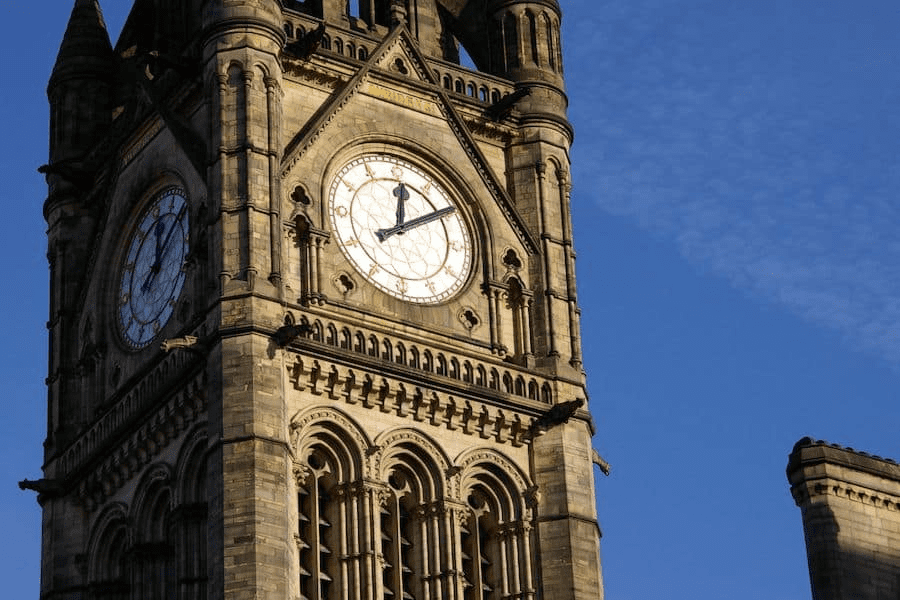
Even many locals are unaware of these fascinating facts about Manchester’s Town Hall clock:
- The great clock bell in the chapel weighs over eight tons.
- Manchester Town Hall and its chapel are Grade I listed buildings, signifying exceptional architectural and national significance.
- The clock mechanism served as a filming location for the 2009 film Sherlock Holmes, starring Robert Downey Jr.
- The chapel bells were cast by John Taylor & Co., a company renowned for producing some of the heaviest bells in the UK.
- In the 21st century, the original carillon mechanism, which plays melodies using 21 bells, continues to chime four times a day.
Significance of the Chapel to Manchester
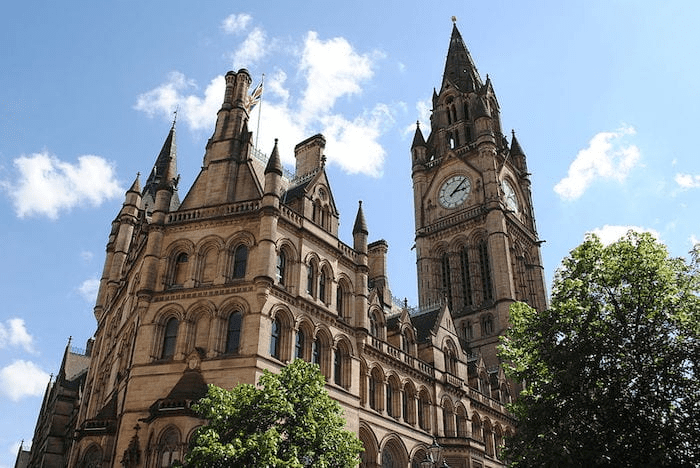
The clock atop Manchester Town Hall holds great importance for the city’s residents. It is not merely a timekeeping device but also a symbol of Manchester’s historical and cultural identity. For decades, the clock and its chimes have been integral to the daily lives of Mancunians. It remains a cherished landmark embodying the spirit and pride of the city.
Furthermore, the chapel and the entire town hall are Grade I listed buildings, underscoring their extraordinary architectural and cultural significance for both Manchester and the UK. Only 2.5% of listed buildings in the country hold this distinguished status.